Conjunction (Basic ㊦ 512)
During a period when a certain situation remains in effect.
Equivalent: While; before; during
| (i) Vinformal nonpast | うちに | (Verb: stative) |
| いるうちに | While someone is there | |
| 話せるうちに | While someone can talk | |
| (ii) Vinformal negative nonpast | うちに | |
| 話さないうちに | Before someone talks | |
| 食べないうちに | Before someone eats | |
| (iii) Vている | うちに | |
| 話しているうちに | While someone is talking | |
| 食べているうちに | While someone is eating | |
| (iv) Adjective い informal nonpast | うちに | |
| 高いうちに | While something is expensive | |
| (v) Adjective な stem | なうちに | |
| 静かなうちに | While something is quiet | |
| (vi) Noun の | のうちに | |
| 休みのうちに | During the vaction |
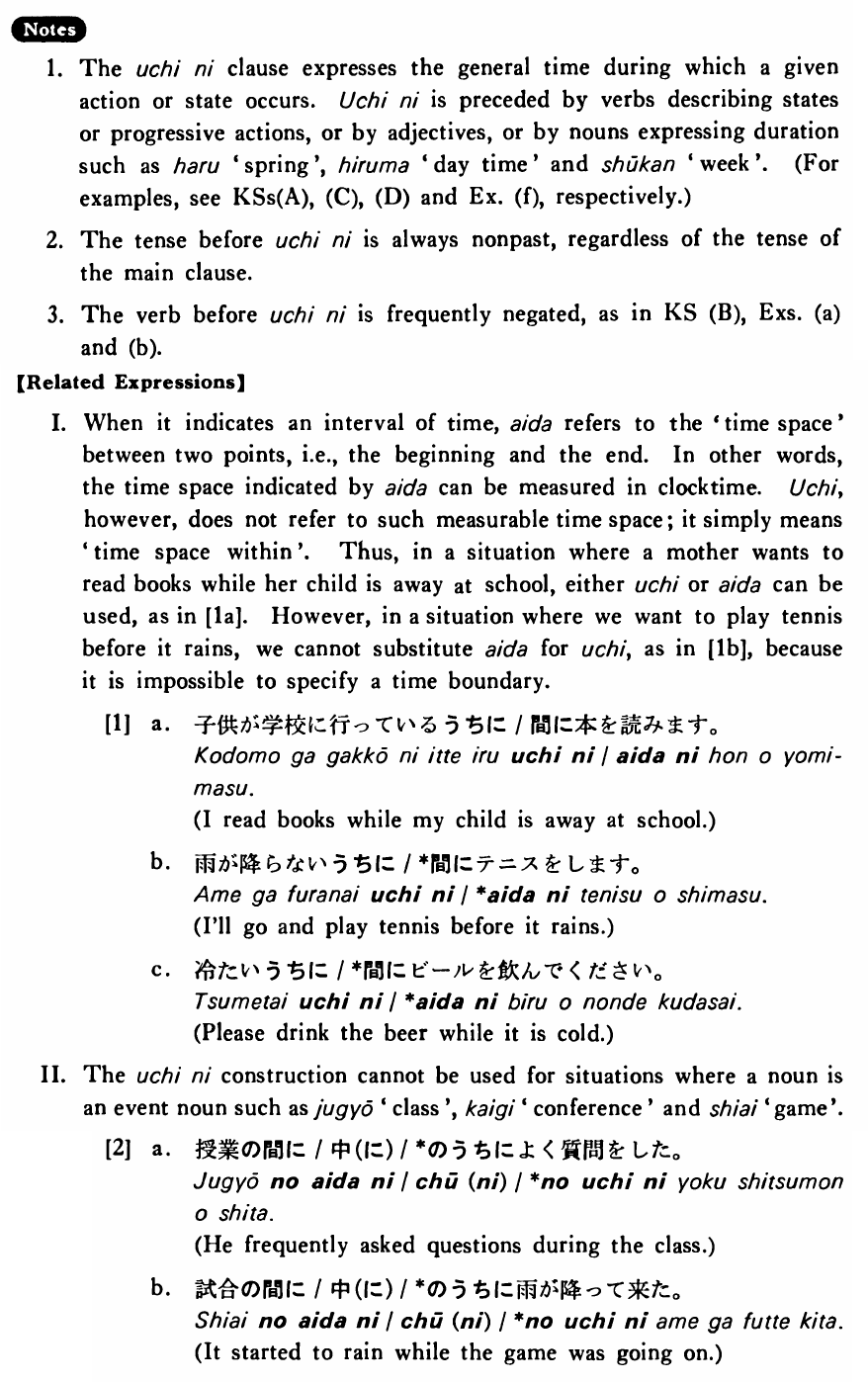
1. The うちに clause expresses the general time during which a given action or state occurs. うちに is preceded by verbs describing states or progressive actions, or by adjectives, or by nouns expressing duration such as 春 'spring', 昼間 'day time' and 週刊 'week'. (For examples, see Key Sentence (A), (C), (D) and Example (f), respectively.)
2. The tense before うちに is always nonpast, regardless of the tense of the main clause.
3. The verb before うちに is frequently negated, as in Key Sentence (B), Examples (a) and (b).
【Related Expressions】
I. When it indicates an interval of time, 間 refers to the 'time space' between two points, i.e., the beginning and the end. In other words, the time space indicated by 間 can be measured in clocktime. うち, however, does not refer to such measurable time space; it simply means 'time space within'. Thus, in a situation where a mother wants to read books while her child is away at school, either うち or 間 can be used, as in [1a]. However, in a situation where we want to play tennis before it rains, we cannot substitute 間 for うち, as in [1b], because it is impossible to specify a time boundary.
[1]
II. The うちに construction cannot be used for situations where a noun is an event noun such as 授業 'class', 会議 'conference' and 試合 'game'.
[2]